What Are the Best Outdoor Rugs for Snowy Climates?
Last Updated: October 28, 2026
Quick Summary
The best outdoor rugs for snowy climates use solution-dyed polypropylene, which absorbs almost no water, resists mildew, and stays flexible in cold better than polyester. Choose a water-resistant flatweave with a breathable backing so meltwater drains instead of freezing against the deck.
- Never roll or fold an outdoor rug while it is frozen; let it thaw and dry first.
- Clear snow after every storm with a plastic shovel or stiff broom, never a metal edge.
- Skip the pressure washer; hose the rug, scrub with mild soap, and dry it flat in the sun.
- Leave a border of bare flooring around the rug so meltwater can drain away.
- Press the rug with your foot on a wet deck to check if it shifts.
Table of Contents
- What Makes an Outdoor Rug Survive a Snowy Climate?
- Polypropylene vs Polyester Outdoor Rugs: Which Handles Cold Better?
- Mold, Mildew, and Moisture: What Snow and Ice Leave Behind
- UV Resistance and Color Retention Through Winter
- Snow Removal and Slip Safety for Porches and Decks
- How to Clean Outdoor Rugs After Winter
- Choosing the Right Rug and Planning Your Setup
- Frequently Asked Questions
What Makes an Outdoor Rug Survive a Snowy Climate?
A winter-ready outdoor rug needs three things: synthetic fibers that resist moisture, a backing that drains instead of trapping water, and color that holds through freeze-thaw cycles. Get all three and a rug can stay on the porch from October to April without turning into a soggy, mildewed mess.
The best outdoor rugs for snowy climates are built differently from the decorative mats sold for mild-weather patios. They're denser, they shed water, and they don't hold a grudge after a February ice storm.
Below, we'll break down what actually separates a winter-tough rug from one that falls apart by January, plus the cleaning and snow-removal habits that keep it usable year after year.
Material Durability and Synthetic Fibers
Natural fibers are the wrong call for a snowy porch. Jute, cotton, and wool absorb water, then hold it against the deck through every freeze. Synthetic yarns are the standard for cold-weather rugs because they don't soak up moisture the same way.
The two workhorses are polypropylene and polyester. Both are solution-dyed, meaning the color runs through the fiber rather than sitting on the surface, and both resist mold and mildew when they dry properly. Fiber density matters as much as fiber type: a tight, heavy-duty construction traps less snow and gives a plastic shovel less to catch on.
Waterproof vs. Water-Resistant Properties
Most outdoor rugs are water-resistant, not waterproof. That distinction matters in a snowy climate. A water-resistant rug sheds surface moisture and dries quickly; a waterproof rug has a sealed barrier that stops water entirely, but that barrier can also trap condensation underneath.
For a snowy porch or deck, water-resistant is usually the better choice. You want a rug that lets moisture pass through and drain away rather than sealing it against the deck surface, where it can freeze and damage treated wood. Pair a moisture-wicking rug with a breathable rug pad, not a solid rubber one, so meltwater has somewhere to go.
Polypropylene vs Polyester Outdoor Rugs: Which Handles Cold Better?
Polypropylene wins for snowy climates. It absorbs almost no water, resists mildew, and stays flexible in cold better than most polyester weaves. Polyester is the softer, more color-rich option, but it's the second choice when temperatures drop and snow sits for days.
Sub-Zero Temperatures and Material Flexibility
Cold makes plastic brittle, and that includes rug fibers. In sub-zero temperatures, cheap synthetic rugs can stiffen and crack along fold lines if you try to move or roll them. Polypropylene holds up better because its fibers stay slightly more pliable, but no synthetic rug likes being dragged across ice.
A practical rule: never roll or fold an outdoor rug when it's frozen. Let it thaw, sweep off the loose snow, and move it only when it's dry and above freezing. That single habit prevents more winter rug damage than any product upgrade.
| Feature | Polypropylene | Polyester |
|---|---|---|
| Water absorption | Very low | Low |
| Cold flexibility | Better | Moderate |
| Color vibrancy | Good | Excellent |
| Mildew resistance | High | Moderate |
| Best for | Snowy porches, entryways | Covered patios, mild winters |
Mold, Mildew, and Moisture: What Snow and Ice Leave Behind
Snow itself isn't the enemy. Trapped moisture is. When snow melts and refreezes on a rug that can't drain, the damp fibers become a breeding ground for mildew, and that musty smell is hard to reverse once it sets in.
Mildew-resistant rugs help, but drainage does more work than any coating. Elevate the rug slightly with a breathable pad, shake it out after storms, and never leave it bunched against a wall where meltwater pools. If you spot dark patches, treat them early with a diluted white vinegar solution and let the rug dry fully in the sun.
UV Resistance and Color Retention Through Winter
Winter sun is weaker, but it still fades cheap dyes, and snow reflects UV light back up at a rug's surface. UV-stabilized fibers resist that fade, which is why solution-dyed polypropylene holds its color through multiple winters while printed rugs go chalky.
Check the label for UV stabilization before you buy. A fade-resistant rug isn't just about looks; color that's baked into the fiber usually signals a denser, better-made weave overall.
For readers building out a full cold-weather setup, outdoor living space ideas for cold weather climates covers the broader design picture beyond the rug itself.
Snow Removal and Slip Safety for Porches and Decks
Most winter rug guides stop at "shovel it off." That advice is incomplete and, done wrong, it destroys the rug faster than the snow would. The technique matters as much as the tool.
How to Clear Snow Without Tearing the Weave
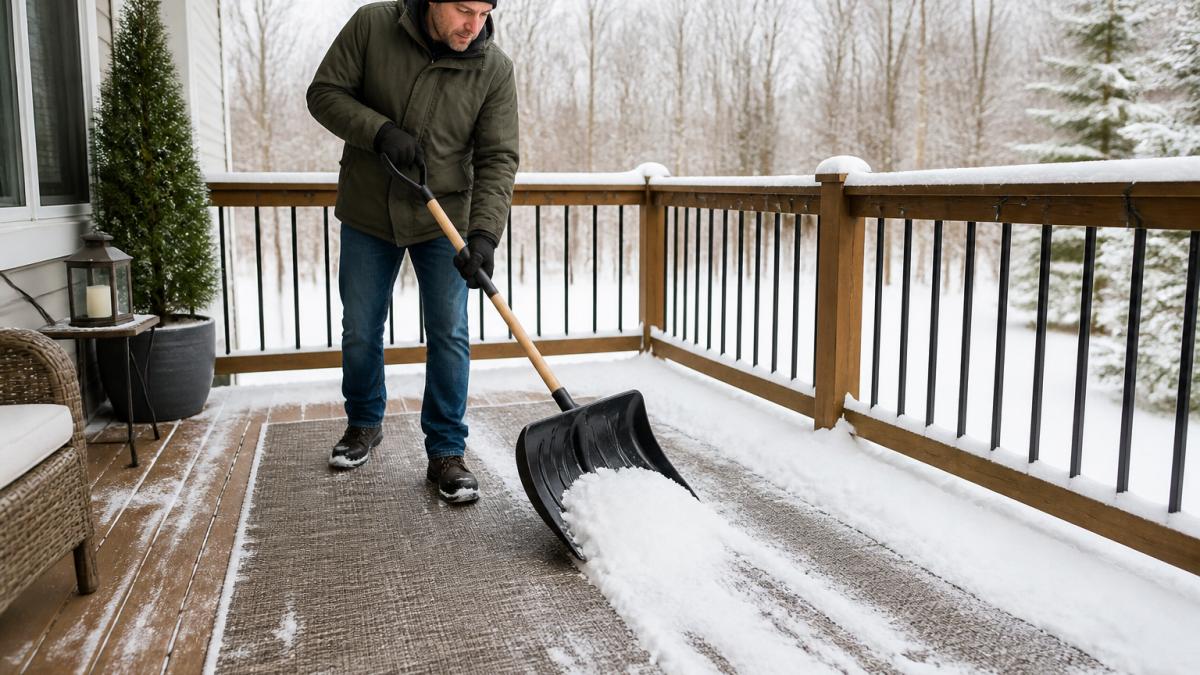
Use a plastic snow shovel or a stiff-bristled broom, never a metal-edged blade. Metal catches looped fibers, pulls them, and leaves a frayed edge that becomes the starting point for ice damage. Work in light, shallow passes rather than trying to push a full load at once. Lift the shovel slightly at the end of each stroke instead of scraping down into the pile.
Clear snow before it compacts. Fresh, fluffy snow brushes off easily; snow that has sat through a freeze-thaw cycle bonds to the fibers and has to be broken loose, which is when most accidental tearing happens. A common pattern is to clear after every storm rather than waiting for a big melt.
Slip-Resistance Ratings for Snowy Entryways
Slip resistance is the safety metric most rug content skips entirely. Wet, icy entryways are where falls happen, and a rug that slides underfoot makes a bad surface worse. Look for a non-slip backing or pair the rug with a rubber-edged mat that grips the deck. Flatweave rugs with a textured underside grip better than smooth-backed ones.
A practical check: press the rug with your foot on a wet deck before the season starts. If it shifts, add a breathable non-slip pad underneath, not a solid rubber sheet, which traps meltwater against the deck. For high-traffic doorways, a low-pile flatweave with a rubberized backing outperforms a plush mat that holds slush.
If wind-driven snow keeps piling against your door, how to build a DIY winter patio windbreak shows how to block it before it reaches the rug.
How to Clean Outdoor Rugs After Winter
Spring cleaning is where a winter rug either gets a second life or gets retired. Start by shaking out loose debris, then hose the rug down and scrub with a mild soap and a soft bristle brush. Rinse until the water runs clear and dry it flat in the sun, flipping once.
Skip the pressure washer on synthetic rugs. High pressure forces water into the backing and can fray the weave. For stubborn stains, a diluted vinegar solution handles most organic marks without harsh chemicals.
While the rug dries, it's a good time to cover nearby furniture so it stays protected during the cleanup. A patio furniture cover set for sofas, loveseats, chairs, and coffee tables keeps nearby pieces protected while the rug is cleaned or stored.
Choosing the Right Rug and Planning Your Setup
Match the rug to the space, not the other way around. Measure your porch or deck, leave a border of bare flooring around the edges so meltwater can drain, and pick a flatweave or low-pile construction for high-traffic areas. High-pile rugs look plush but trap snow and take far longer to dry.
If durability across the whole patio is the goal, durable outdoor furniture for harsh winters pairs well with a winter-tough rug. At Backyard Comfort CO, we offer weather-ready designs and a 30-day return policy.
| Priority | What to Look For | Why It Matters |
|---|---|---|
| Drainage | Breathable backing, flatweave | Prevents trapped meltwater |
| Fiber | Solution-dyed polypropylene | Resists mildew and fade |
| Safety | Non-slip backing | Reduces slips on icy entryways |
| Maintenance | Low pile, easy to hose | Faster spring cleanup |
Frequently Asked Questions
Can you leave outdoor rugs outside during winter?
Yes, if the rug is built for it. Polypropylene and solution-dyed synthetic rugs with a flatweave construction and non-slip backing can stay out through snow and ice. Natural fiber rugs, hand-hooked wool, and anything with a cotton backing should come inside. Check the label for water-repellent and mildew-resistant claims before you commit to leaving a rug on an exposed deck or porch all season.
What material is best for outdoor rugs in snowy climates?
Polypropylene wins for most snowy porches. It absorbs almost no water, resists mildew, and holds up to freezing and thawing without cracking. Polyester is a close second and takes dye well, so it keeps color longer in strong sun. Both are UV-stabilized in quality rugs. Avoid jute, sisal, and cotton, which soak up moisture and break down after a few freeze cycles.
Do outdoor rugs get ruined by snow and ice?
Snow alone rarely ruins a synthetic outdoor rug. The damage comes from what sits under it: trapped moisture, ice buildup that grinds fibers, and mold that grows when the rug stays wet for weeks. Shovel snow off rather than letting it pile up, lift the rug to dry on mild days, and make sure water drains away from the deck surface. A rug that dries out periodically will last many seasons.
Should I roll up my outdoor rug for the winter?
Roll it up if the rug sits in a spot that stays wet, if it is a lighter weight weave, or if your area gets heavy ice storms. Leave it down if it is a heavy-duty polypropylene rug on a covered porch with good drainage. Either way, clean and dry the rug fully before storing it, and store it rolled, not folded, in a dry space away from rodents.
A snowy climate is hard on outdoor living spaces, but the right rug and a few seasonal habits keep yours usable all winter. Backyard Comfort CO builds durable, weather-ready outdoor pieces designed to last through every season, with free shipping on most orders within the continental U.S. and a straightforward 30-day return policy. Get started with Backyard Comfort CO and create a patio that stays comfortable year after year.