How to Maintain Wood Pergolas: A 2026 Guide
Table of Contents
- What You'll Need Before You Start
- Annual Visual Inspection Checklist for Wood Pergolas
- Wood Pergola Cleaning Tips That Won't Damage the Grain
- How Often to Stain a Wood Pergola by Climate and Species
- Best Wood Sealer for Outdoor Pergolas: What to Look For
- Sanding, Surface Prep, and Applying a Fresh Finish
- Seasonal Maintenance Schedule to Maintain Wood Pergolas Year-Round
- Common Mistakes That Shorten a Wood Pergola's Life
Last Updated: August 21, 2026
Maintaining a wood pergola is not complicated, but most homeowners get it wrong by waiting too long between treatments. This guide on how to maintain wood pergolas covers everything from annual inspections to climate-specific staining schedules, so your structure stays sound and looks sharp for years to come.

The biggest misconception is that a wood pergola is "set and forget." Wood is a living material that responds to moisture, UV radiation, and temperature swings. Without regular exterior wood care, even pressure-treated lumber will develop mold, splintering, and eventually wood rot.
What You'll Need Before You Start
Before any maintenance session, gather your supplies. Working with the right tools makes the difference between a job that protects the wood grain and one that damages it.
Basic maintenance kit:
- Soft bristle brush (never wire bristle on bare wood)
- Garden hose with adjustable nozzle
- Bucket, mild detergent, and white vinegar
- Wood cleaner or oxygen bleach solution
- 80-grit and 120-grit sandpaper (or orbital sander for large surfaces)
- Wood sealer or penetrating stain with UV protection
- Natural-bristle brush or foam roller for finish application
- Drop cloths and painter's tape
- Safety glasses and gloves
Choose an oxygen bleach solution over chlorine bleach whenever possible. Chlorine bleach can break down wood fiber over time and discolor cedar. For eco-friendly cleaning, oxygen bleach paired with a small amount of dish soap handles mildew and mold without stripping the wood's natural oils.
Annual Visual Inspection Checklist for Wood Pergolas
A thorough annual inspection is the foundation of how to maintain wood pergolas effectively. Do this every spring before the heat sets in, and again in late fall before freezing temperatures arrive.

Checking Structural Beams and Posts
Structural integrity is the first priority. Work from the ground up, checking each post base where it contacts the ground or mounting hardware. This is where moisture content tends to stay highest, and where wood rot typically starts.
Structural inspection checklist:
- Check post bases for soft spots, discoloration, or crumbling wood fiber
- Inspect all hardware connections (bolts, brackets, post anchors) for rust or loosening
- Look along structural beams for sagging or bowing
- Press a screwdriver firmly into posts and beams; sound wood resists; rotted wood gives way
- Verify all decorative post skirts are seated properly and not trapping moisture against the post
- Confirm the overall structure doesn't shift or wobble when moderate lateral pressure is applied
If a post base shows signs of active wood rot, address it before applying any finish. Sealing over decayed wood accelerates the problem by trapping moisture inside.
Spotting Wood Rot, Warping, and Splintering
Wood rot is the decomposition of wood fiber caused by fungal growth, typically triggered by persistent moisture exposure. It appears as soft, discolored, or crumbly sections and must be cut out and repaired before any staining or sealing.
Look for these warning signs: warping and checking (cupped or twisted boards and surface cracks running along the grain), splintering (raised fibers along railings and beams), gray or black discoloration (UV protection worn off or mildew growth), and soft spots on rafters where water pools after rain.
According to Forest Products Laboratory wood decay guidance, fungi that cause wood rot require moisture content above roughly 28% to thrive. Keeping your pergola properly sealed and clear of debris is the most reliable way to stay below that threshold.
Wood Pergola Cleaning Tips That Won't Damage the Grain
The most common cleaning mistake is reaching for a pressure washer at high PSI. That approach strips protective coatings, raises wood grain, and forces water deep into the wood fiber, exactly the conditions that promote mold and mildew growth.
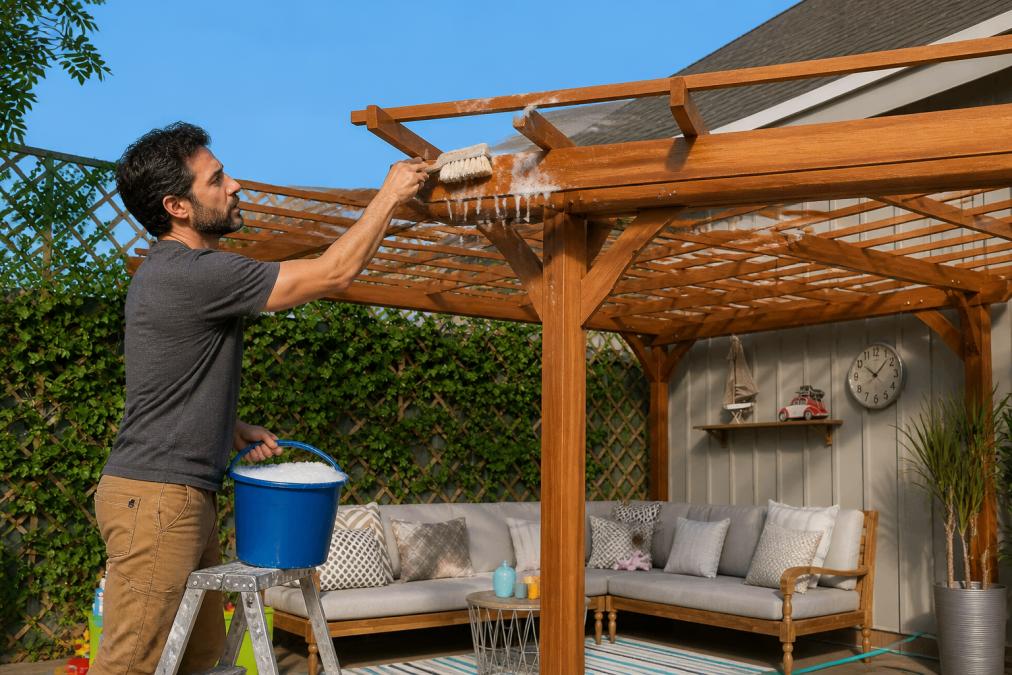
Start with a soft bristle brush and a diluted cleaning solution. Work with the wood grain, not across it. Rinse thoroughly with a garden hose on a low-pressure setting, then allow the wood to dry fully, at least 48 hours in warm weather, before applying any stain or sealer.
| Cleaning Method | Best For | Avoid When |
|---|---|---|
| Soft brush + mild detergent | Routine annual cleaning | Never avoid, always safe |
| Oxygen bleach solution | Mold, mildew, and gray weathering | Freshly stained surfaces |
| Garden hose rinse | Post-cleaning flush | Temperatures below 40°F |
| Low-PSI pressure wash | Heavy grime on sound finishes | Bare or weathered wood |
| Vinegar + water mix | Light mildew on unfinished wood | Sealed or stained surfaces |
Eco-Friendly Cleaning Solutions to Use
Oxygen bleach is the most effective eco-friendly option for wood pergola cleaning. Mix one cup of oxygen bleach powder per gallon of warm water, apply with a soft bristle brush, let it sit for 10-15 minutes, then rinse with a garden hose. For light cleaning, a solution of one part white vinegar to three parts water works well on unfinished or lightly weathered wood. The EPA's Safer Choice program for cleaning products provides a searchable database of verified low-toxicity cleaners if you prefer a commercial product.
Pressure Washing Warnings You Should Know
Pressure washing a wood pergola is possible, but the settings matter enormously. Many homeowners use the same PSI they'd use on concrete, that's too aggressive for any wood species.
Safe pressure washing guidelines for wood pergolas:
- Maximum 1,500 PSI for pressure-treated lumber; 1,200 PSI or lower for cedar
- Use a wide-angle fan tip (40-degree nozzle), never a zero-degree or turbo tip
- Keep the nozzle at least 12 inches from the wood surface
- Always move parallel to the wood grain
How Often to Stain a Wood Pergola by Climate and Species
How often to stain a wood pergola depends on two variables: the wood species and the local climate. In arid climates with intense UV exposure, UV protection breaks down faster and staining every 18-24 months is realistic. In humid coastal climates, mildew and moisture penetration are the primary threats. Cold northern climates with freeze-thaw cycles stress the wood differently, and a penetrating oil-based stain that maintains flexibility outperforms a rigid film-forming finish.
A simple field test: sprinkle water on the surface of a clean, dry board. If the water beads, the sealer is still working. If it soaks in within 30 seconds, it's time to restain.
Cedar vs. Pine: Staining Frequency Differences
Cedar and pine are the two most common species in residential pergolas, and they behave very differently under weather exposure.
Cedar contains natural oils that resist insect damage and decay. These oils slow moisture absorption, which means a quality stain penetrates more slowly but lasts longer once cured. A well-maintained cedar pergola typically needs restaining every 2-3 years in moderate climates. The 10 Ft. x 10 Ft. Traditional All Cedar Wood Outdoor Patio Pergola from Backyard Comfort CO is noted as 100% cedar and pre-stained from the factory, which gives it a head start on protection.

Pine (including pressure-treated lumber) absorbs stain more readily because it lacks cedar's natural oils. Expect to restain pine pergolas every 1-2 years in high-UV or high-humidity environments.
Best Wood Sealer for Outdoor Pergolas: What to Look For
The best wood sealer for outdoor pergolas is a penetrating, oil-based formula with UV blockers and a water repellent component. Film-forming sealers (those that sit on top of the wood rather than soaking in) look excellent when new but tend to peel and crack as the wood expands and contracts seasonally.
What to look for on the product label:
- "Penetrating" or "oil-based" formula
- UV protection or UV inhibitors listed as an active component
- Water repellent or waterproofing properties
- Mildewcide additive (especially important in humid climates)
- Compatibility with the wood species you're treating
Semi-transparent stains offer the best combination of color, UV protection, and stain penetration. According to USDA Forest Service guidance on exterior wood finishes, penetrating finishes generally outperform film-forming finishes on exterior wood that experiences direct weather exposure.
Sanding, Surface Prep, and Applying a Fresh Finish
Surface preparation is where most DIY refinishing jobs fail. Applying a fresh stain over a dirty, chalky, or incompletely stripped surface is the single biggest reason finishes fail prematurely.
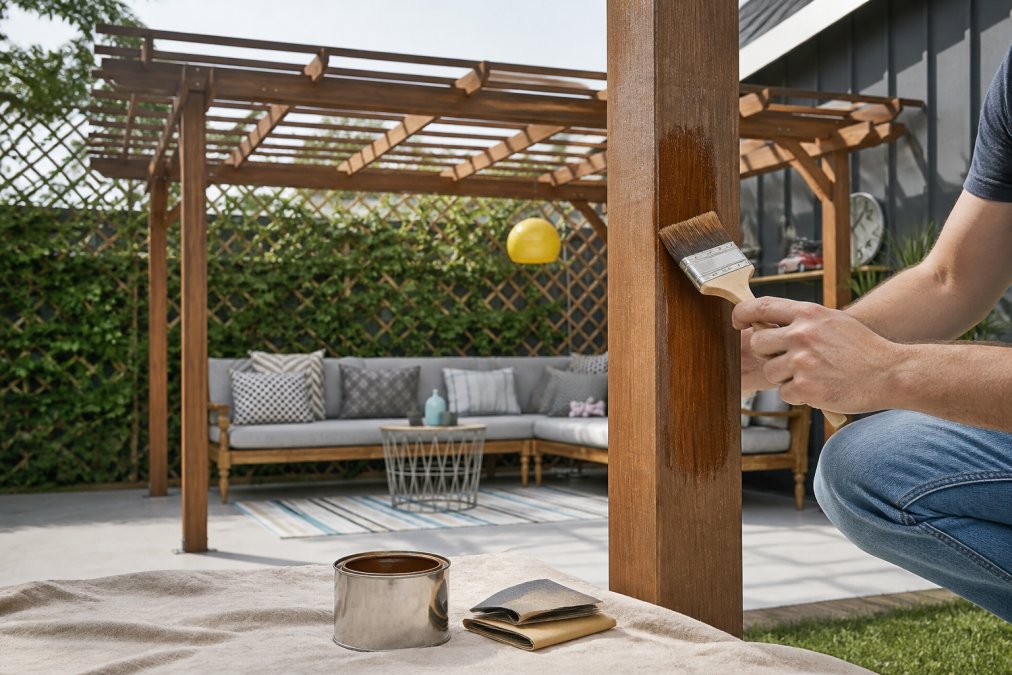
Step-by-step surface prep process:
- Clean the surface using the eco-friendly cleaning method described above. Allow to dry completely (48-72 hours minimum).
- Assess the existing finish. If the old stain is peeling, use a chemical stripper formulated for exterior wood. If it's worn but not peeling, light sanding is sufficient.
- Sand with 80-grit paper to remove any remaining old finish, raised grain, or rough spots. Work with the grain.
- Follow with 120-grit paper to smooth the surface and open the wood pores for better stain penetration.
- Remove all dust with a tack cloth or clean brush.
- Apply the first coat of stain or sealer using a natural-bristle brush or foam roller. Work the product into the wood grain rather than simply painting the surface.
- Allow the first coat to penetrate per the manufacturer's recommended dwell time, then wipe away any excess before it becomes tacky.
- Apply a second coat after the first has dried fully. Two thin coats outperform one heavy coat for both penetration and finish longevity.
Seasonal Maintenance Schedule to Maintain Wood Pergolas Year-Round
A structured seasonal schedule is the most reliable way to maintain wood pergolas without letting small issues escalate.
| Season | Task | Time Required |
|---|---|---|
| Spring | Full inspection, cleaning, assess finish condition | 3-4 hours |
| Spring (if needed) | Sanding, restaining, and sealing | 1-2 days |
| Summer | Debris removal, check for insect activity | 30 minutes |
| Late Summer | Water bead test to assess sealer performance | 10 minutes |
| Fall | Clear leaves and debris, inspect hardware for rust | 1 hour |
| Fall | Apply water repellent if bead test failed in summer | 2-3 hours |
| Winter | Monthly debris check in snow-prone climates | 15 minutes |
Wood-boring insects like carpenter bees are drawn to bare, unfinished wood. Keeping your pergola sealed is the most effective deterrent. The fall maintenance window is underrated: clearing leaf debris from the top of the pergola before winter prevents moisture buildup during freeze-thaw cycles.
Common Mistakes That Shorten a Wood Pergola's Life
After years of watching homeowners invest in quality structures only to undermine them with avoidable errors, the patterns are clear.
Sealing over wet wood is the most destructive mistake. Moisture trapped under a water repellent or sealer cannot escape, which accelerates wood rot from the inside out. Always verify the wood is fully dry before applying any finish.
Using the wrong cleaner: Chlorine bleach is effective at killing mold but degrades wood fiber and strips natural oils from cedar. Stick to oxygen bleach for mold and mildew treatment.
Ignoring the post bases: The bottom 6 inches of each post take the most abuse. Moisture wicks up from the ground or deck surface, hardware traps water against the wood, and this area gets the least UV exposure to help it dry out. Check post bases every season without exception.
Skipping the water bead test: Many homeowners restain on a fixed calendar regardless of actual finish condition. The bead test takes 30 seconds and tells you exactly whether the sealer is still working.
Pressure washing bare wood: This raises the wood grain significantly and forces water into the wood fiber. If you pressure wash bare wood, you must sand before applying any finish.
Neglecting climbing plants: Climbing plants look beautiful on a pergola but hold moisture against the wood surface. Trim them back annually and inspect the contact points for mold or early decay.
Wood pergolas are a long-term investment, and the maintenance they require is modest compared to the value they add. Backyard Comfort CO's solid wood pergolas are designed with weather-ready construction to handle seasonal stress, but the routine care outlined above is what takes a structure from lasting a decade to lasting a generation. A consistent inspection and refinishing schedule is what protects that investment. Explore Backyard Comfort CO's pergola collection and get started with a structure built to last.
Frequently Asked Questions
What is the life expectancy of a wooden pergola?
A well-maintained wood pergola typically lasts 10 to 25 years, depending on the species and how consistently it receives care. Cedar and pressure-treated lumber tend to resist moisture, insects, and decay naturally. Annual inspections, regular cleaning, and resealing every one to three years are the biggest factors that extend a pergola's structural integrity well beyond the lower end of that range.
Should I seal my cedar pergola, and how often?
Yes, sealing a cedar pergola is worth doing even though cedar has natural oils that resist moisture. A penetrating wood sealer with UV protection slows weathering, prevents mildew, and keeps the wood grain looking rich rather than gray. Plan to reseal every one to two years in humid or high-sun climates, and every two to three years in milder regions. Check whether water still beads on the surface, if it soaks in, it's time to reseal.
Can I power wash a wood pergola?
Power washing is risky on wood pergolas. High pressure can tear wood fibers, raise the grain, and drive moisture deep into the lumber, which accelerates warping and checking. If you use a pressure washer, keep the PSI below 1,200, hold the nozzle at least 12 inches from the surface, and always spray along the wood grain, never across it. A soft bristle brush with a mild detergent or diluted bleach solution is safer and just as effective for most cleaning jobs.
How often should I clean my wood pergola?
A light cleaning with a soft bristle brush and mild detergent twice a year, once in spring and once in fall, keeps debris, mold, and mildew from building up. After heavy storms or periods of high humidity, a quick rinse with a garden hose helps prevent moisture from sitting on the wood surface. A deeper clean with a diluted bleach solution or eco-friendly wood cleaner is typically needed once a year before you restain or reseal.
This article was written using GrandRanker